
Global oil prices fell on Thursday to their lowest levels since before the outbreak of the Iran conflict, offering a significant economic tailwind for India, the world's third-largest crude importer, by easing inflation risks, reducing the import bill and improving the government's fiscal position.
The advanced economies have been experiencing their longest period of slow growth.

'They talked bad about our leaders. They said India was a dead economy. They were not sensitive to the Indian psyche.'

Equity benchmark indices Sensex and Nifty tumbled in early trade on Monday, with the 30-share BSE Sensex falling 1,613.09 points and the 50-share NSE Nifty plunging 495 points, as the failure of US-Iran negotiations heightened concerns of a prolonged conflict driving crude oil prices sharply higher. Track Sensex, Nifty50 movement and key market drivers for April 13, 2026.

US Secretary of State Marco Rubio said that discussions aimed at halting the conflict with Iran have shown "some slight progress," while simultaneously echoing Washington's dissatisfaction with its NATO allies.
India's wholesale price index (WPI) inflation surged to 9.68 per cent in May, up from 8.26 per cent in April, primarily due to significant increases in the prices of fuel and power, manufactured goods, and food items.
S&P Global Ratings warns that a sustained rise in crude oil prices to $130 per barrel could significantly slow India's economic growth, weaken fiscal metrics, and strain corporate and banking sector performance, potentially reducing growth by up to 80 basis points.

Prem Panicker's Must Read Blog On The Gulf War.

'The flip side of this is that he won't hesitate to call out India if he thinks its policies are hurting US economic interests or border US foreign policy goals.'

A few frantic calls later, the answer emerged: She had missed her connecting flight in London. Not because she was late. Not because she couldn't walk fast enough. She had simply gone to the wrong gate, sat down, and waited.

External Affairs Minister S Jaishankar has strongly defended India's decision to purchase Russian crude oil, stating that the country's energy choices are based on cost and availability, and highlighting the West's 'hypocrisy' in criticising India while historically supplying weapons used against it.

India's Goods and Services Tax (GST) collections saw a significant 14 per cent increase in June, reaching approximately Rs 1.95 lakh crore. This surge was primarily driven by a substantial 34.6 per cent growth in tax mop-up from imports, alongside a 6.5 per cent rise in domestic supplies, reflecting the country's economic resilience despite global uncertainties.

A Chinese official stated that India and China should view each other as cooperative partners and opportunities for development, not rivals or threats. This statement came in response to Russian President Vladimir Putin's comments on the independent and strong ties Russia maintains with both nations, emphasising non-interference in India-China relations.
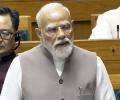
Modi said that the West Asia crisis has been going on now for more than three weeks and is having a very adverse impact on the global economy and on people's lives. He said the entire world is urging all parties for the earliest resolution of this crisis.

IT stocks had their worst first half fall in decades, with the Nifty IT index declining 31% in the January-June 2026 period, its biggest decline in the first six months of a calendar year since 2003.
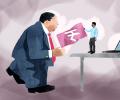
India's services sector growth experienced a significant slowdown in June, reaching a 17-month low due to challenging market conditions and reduced domestic client interest, as indicated by the HSBC India Services PMI Business Activity Index.

'Investors shouldn't let fear dictate their decisions. The most important step is simply to begin investing.'

CAT and MBA expert and rediffGURU Patrick D'Souza explains how a simple daily reading habit can help aspirants clinch 99 percentile in the Common Admission Test this year.

India's economy registered a robust 7.7 per cent growth in the fiscal year 2025-26, an increase from 7.1 per cent in the previous year, with the January-March quarter alone seeing a 7.8 per cent expansion.


Russian President Vladimir Putin will attend the BRICS summit in New Delhi on September 12-13, according to a presidential aide.

India's first trillion-dollar company will be built on technology it owns, not just operates, predicts Ajay Kumar.

Indian benchmark indices Sensex and Nifty rebounded in early trade, recovering from previous losses, driven by softening crude oil prices and renewed buying interest in blue-chip stocks. Analysts note that the fall in Brent crude below USD 77 has removed significant macro headwinds for India, contributing to market stability.

The IMF has encouraged both the UK and the EU to work collaboratively towards a smooth transition.
Despite the sub-prime mortgage crisis taking hold in industrialized nations, the overall global economy was still growing in 2007, a new United Nations report says.

Tamil Nadu's new government, led by C Joseph Vijay, is committed to advancing the ~38,000 crore shipbuilding project with HD Hyundai in Thoothukudi, securing bipartisan support from the Opposition DMK, despite initial industry concerns about policy continuity after the change in leadership.

'Markets never fully lose hope. But an important shift could come if the Strait remains closed -- moving from high prices to no prices.'

India should not stay on the margins of this initiative. There should be a serious debate about what would be in India's best interests asserts former foreign secretary Shyam Saran.

Prime Minister Narendra Modi has urged states to balance the opportunities presented by artificial intelligence with the need to safeguard against social challenges like cyber fraud and drug abuse. He also warned of the risks posed by El Nino conditions, calling for stronger water conservation measures and emphasising the collective resolve towards a 'Viksit Bharat'.

The global economy in 2011 and 2012 is shifting into a phase of slower but solid growth, with India and China contributing towards almost half of the global growth, says the World Banks latest Global Economic Prospects 2011 report.
Indian benchmark indices Sensex and Nifty closed lower, snapping a two-day rally, as a spike in crude oil prices, triggered by reports of fresh US military operations in southern Iran, dampened investor sentiment and reignited fears of renewed energy supply disruptions.

History may remember Takaichi Sanae not as the leader who simply accelerated Japanese rearmament, but as one who governed during Japan's transition from an industrial-age security model to a post-industrial strategic member of the global order, points out Varun Arya.
The OECD projects India's GDP to grow at 7.6% in the current fiscal year and 6.1% in 2026-27, despite global economic challenges stemming from the Middle East conflict and energy price volatility.

Prime Minister Narendra Modi and US President Donald Trump exchanged pleasantries and held a brief conversation at the G7 summit, their first in-person encounter in 16 months, setting the stage for high-stakes bilateral talks amidst continuing strain in India-US relations.
BRIC nations will become the "locomotive" to pull the global economy out of the current crisis as two major countries of the bloc -- India and China -- have suffered least from the downturn, Russian Deputy Prime Minister Sergei Ivanov has said.

'The main problem the country faces is not low GDP growth, but low employment growth.'

India has expressed firm opposition to attacks on merchant shipping amidst the ongoing Iran conflict, revealing that several Indian nationals have died or are missing due to these incidents. The nation also called for restraint, de-escalation, and prioritising civilian safety in the region.

Chief Economic Advisor V Anantha Nageswaran stated that India's economy is projected to return to a 7 per cent-plus growth trajectory by 2027-28 (FY28), or sooner if external conditions improve, despite near-term challenges from the West Asia crisis.

United States President Donald Trump has issued a strong warning to Iran, asserting that any attempt to impede the transit of petroleum through the Strait of Hormuz would be met with massive military retaliation.

The United States and India are on the verge of finalising a landmark bilateral trade deal, aiming to boost trade to USD 500 billion by 2030, according to US Deputy Assistant Secretary of State Bethany Poulos Morrison. The agreement seeks to open India's 1.4 billion-strong market to American goods on reciprocal terms, with ongoing high-level discussions to recalibrate the pact after recent changes in US tariff policy.
